
The contemporary Enterprise AI Integration is caught in a profound architectural squeeze. On one side lies the immense commercial pressure to deploy autonomous artificial intelligence agents capable of executing complex, multi-step business workflows. On the other side sits the reality of the existing corporate digital footprint: a deeply entrenched ecosystem of monolithic Enterprise Resource Planning (ERP) engines, legacy Customer Relationship Management (CRM) architectures, and rigidly structured relational database clusters.
The core challenge for Chief Technology Officers and enterprise architects in 2026 is not the procurement of raw algorithmic capability. Rather, it is the mitigation of the severe structural friction that occurs when non-deterministic machine learning entities are wired directly into deterministic legacy infrastructure.
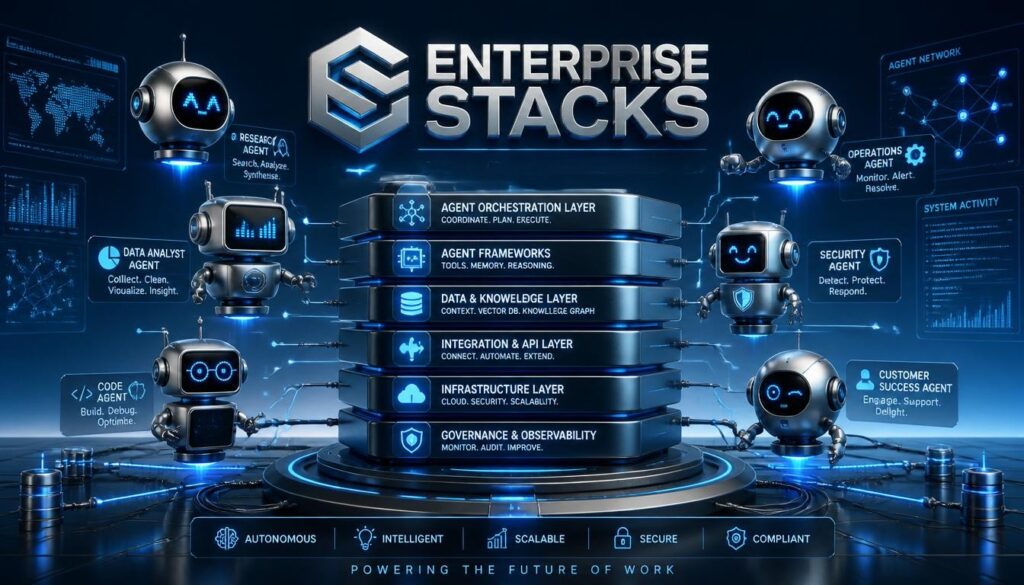
To bridge this operational divide, organizations must move beyond superficial API wrappers and construct a dedicated Cognitive Integration Layer. This manual deconstructs the structural bottlenecks, systemic risks, and architectural blueprints required to safely overlay autonomous intelligence across highly secure, legacy enterprise environments.
1. The Core Imbalance: Non-Deterministic Intelligence vs. Deterministic Core Systems
At the heart of the integration crisis is a fundamental mismatch in computational theory. Legacy enterprise core applications are fundamentally deterministic. Systems like financial ledgers, inventory tracking databases, and regulatory compliance logs operate on an absolute paradigm: given a specific input, the system must produce an identical, completely predictable output every single time. These platforms achieve transactional integrity through strict schema enforcement, explicit foreign key constraints, and transactional ACID compliance protocols.
Conversely, autonomous AI agents built on large language models and neural networks are non-deterministic and probabilistic. They do not operate within binary logic trees; instead, they navigate highly complex vector spaces, calculating the mathematical probability of the next most logical token, action, or tool call.
When an autonomous agent is granted programmatic access to write data directly back into a legacy transactional core, this non-deterministic behavior introduces immense systemic risks:
- Schema Corruption: An autonomous agent generating unstructured or semi-structured data payloads (such as malformed JSON packets) can easily bypass loose interface validations, resulting in broken database constraints and corrupted tables downstream.
- State Machine Disruption: Legacy business systems rely heavily on step-by-step state changes (e.g., transitioning a purchase order from “Pending” to “Approved” only after a distinct multi-factor verification chain). An autonomous agent executing asynchronous system calls can inadvertently trigger race conditions or skip critical conditional verification steps entirely.
- Algorithmic Cascades: In highly integrated environments, a single hallucinated tool execution by an intelligent agent can propagate false information across multiple synchronized microservices, leading to automated compounding data corruption that is exceptionally difficult to track and roll back.
To prevent these failure states, enterprise architects must establish a strict decoupling methodology, treating the autonomous AI agent as an unverified external consumer that must pass through an absolute validation abstraction layer before interacting with the corporate core.
2. Deconstructing the Database Bottleneck: SQL, NoSQL, and High-Dimensional Vector Spaces
The secondary friction point exists at the data storage layer. Legacy enterprise systems are built to query structured rows and columns using traditional indexing methods. Autonomous AI agents, however, perceive corporate intelligence through high-dimensional vector embeddings mathematical representations of semantic meaning generated by parsing unstructured corporate documents, support logs, and communication data.
To make legacy corporate assets accessible to an intelligent agent without executing high-risk, multi-million dollar data migration projects, organizations must engineer a unified storage environment. This is achieved by implementing the Data Lakehouse pattern over existing object storage and linking it dynamically to transactional data lakes.
| Feature Set | Legacy Relational Data Core (SQL) | Autonomous Vector Storage Layer | Integrated Lakehouse Hybrid |
| Data Modality | Highly structured tabular rows/columns | High-dimensional dense float arrays | Unified relational views over vector indices |
| Query Engine | Exact matching via B-Tree / LSM indexes | Approximate Nearest Neighbor (ANN) search | Multi-modal SQL queries with semantic modifiers |
| Consistency Baseline | Immediate ACID compliance | Eventual consistency across nodes | Transactional metadata-driven consistency |
| Primary Use Case | Transaction ledger processing, billing | Semantic context retrieval (RAG) | Real-time cross-referencing of operational data |
Implementing the Metadata Transaction Abstraction
Rather than forcing legacy SQL databases to perform highly inefficient vector calculations, or moving all corporate records into isolated vector databases, the Cognitive Layer relies on a metadata abstraction layer.
When an agent issues a semantic request, the query is intercepted by a massively parallel processing compute engine. This engine scans the vector index to locate the relevant semantic context, isolates the corresponding metadata attributes (such as unique corporate identification numbers or ledger transaction keys), and then executes a highly optimized, exact-match SQL join against the legacy relational core. This ensures that while the agent thinks in terms of abstract concepts and semantic meaning, the ultimate data retrieval remains grounded in precise, auditable database records.
3. The API Integration Deficit: Transitioning from Batch Processing to Real-Time Event Loops
For decades, enterprise application integration relied on structured, scheduled batch processing or highly predictable webhooks. Systems would synchronize data at midnight, or transfer strict XML/JSON payloads across predefined enterprise service bus architectures.
Autonomous agents break this paradigm completely. An agent does not operate on a static schedule; it functions within an active, real-time conversational event loop. It continuously assesses environmental stimuli, interprets user intent, calls unexpected APIs in non-linear sequences, and processes unstructured responses dynamically.
Designing Idempotent Agent Endpoints
Exposing standard REST APIs directly to autonomous workflows is an operational hazard. If an agent experiences a network timeout or receives an ambiguous response from a core system, its internal reasoning engine may prompt it to repeatedly re-execute the action. In a non-idempotent environment, this behavior can result in duplicated financial transactions, repeated inventory shipments, or multiple customer account creations.
To prevent this, every API endpoint exposed to the Cognitive Layer must be engineered for absolute idempotency. The integration layer must force the agent to pass a unique, cryptographically signed token with every request execution. If the agent retries an action due to a perceived communication error, the idempotency gateway identifies the token, blocks secondary execution against the legacy system, and safely returns the cached result of the initial execution.
4. Zero-Trust Security Micro-Segmentation for Autonomous Entities
Traditional identity and access management (IAM) models are built around human operators or explicit service accounts with fixed, static permissions. When an enterprise software application needs to talk to a database, it uses a highly privileged service key that provides wide access to specific data tables.
This approach is highly dangerous when applied to autonomous AI agents. Because these agents possess the capability to write their own code modifications, call external tools, and parse unstructured information, they represent an entirely new vector for advanced prompt injection attacks. If a malicious actor subtly alters a document stored within a corporate repository, an agent reading that file could have its internal instructions hijacked, causing it to abuse its service account permissions to exfiltrate database contents or execute destructive system actions.
The Identity and Access Architecture of the Cognitive Layer
To mitigate this risk, the Cognitive Integration Layer enforces a radical adaptation of Zero-Trust Network Architecture (ZTNA) specifically tailored for algorithmic workloads:
- Dynamic, Ephemeral Token Generation: Autonomous agents are never granted permanent, long-lived access credentials or static API keys. Instead, every action execution triggers an ephemeral, short-lived token that is cryptographically bound to a single transaction cycle. The token self-destructs the moment the specific task lifecycle concludes.
- Contextual Attestation Engines: Before the integration gateway authorizes an agent’s API request to a legacy core system, an independent attestation engine evaluates the contextual legitimacy of the call. The engine analyzes the agent’s current reasoning trail, historical execution patterns, and real-time risk scores. If an agent suddenly attempts to access bulk financial data while executing a routine customer support workflow, the request is immediately blocked and flagged for human intervention.
- Micro-Segmented Data Sandboxing: Every runtime environment allocated to an autonomous agent is heavily isolated using containerized software perimeters. The agent operates within a logical sandbox, meaning it possesses zero visibility into adjacent enterprise networks or microservices unless a specific communication pathway is explicitly whitelisted by deterministic corporate firewall policies.
5. Strategic Implementation Roadmap: Building the Decoupling Layer
Retrofitting an enterprise technology stack for autonomous intelligence cannot be achieved through a massive, all-at-once system replacement. The operational risk to core business continuity is simply too great. Instead, enterprise leadership must adopt a phased deployment blueprint modeled after the Strangler Fig Application pattern. This methodology allows organizations to systematically build the Cognitive Layer piece by piece, safely isolating legacy systems while steadily expanding agent execution capabilities.
Phase 1: Read-Only Shadow Isolation
The initial phase focuses entirely on data extraction and semantic indexing without altering core system code. Organizations deploy read-only data replication pipelines that copy information from legacy databases into a secure, centralized object storage architecture.
From there, automated vector embedding engines ingest the data, building a comprehensive knowledge graph and semantic search index. At this stage, autonomous agents are completely blocked from writing data back to the core. They function purely as intelligent search assistants, allowing engineering teams to evaluate model accuracy, fine-tune retrieval-augmented generation (RAG) pipelines, and monitor for data drift in a totally safe environment.
Phase 2: Bidirectional Abstraction and Idempotency Enforcement
Once semantic retrieval is fully optimized, organization teams begin building the outbound transaction framework. This phase involves wrapping core legacy system functionalities in strict, idempotent API gateways.
Engineers develop the intermediary software abstraction layers responsible for parsing agent intents, sanitizing outbound JSON payloads, and validating data compliance against rigid corporate schemas. Agents are given limited operational capabilities such as updating a customer contact field or generating an internal draft invoice under close system telemetry and deterministic supervision.
Phase 3: Autonomous Orchestration with Continuous Telemetry
The final phase involves activating the complete, multi-agent operational loop. The Cognitive Layer assumes full responsibility for token lifecycle management, contextual zero-trust security attestation, and real-time model monitoring.
Comprehensive telemetry systems continuously capture performance data, tracking API latencies, token consumption efficiencies, and error budget metrics. If an automated workflow encounters an operational anomaly or deviates from strict corporate behavioral guardrails, the system automatically triggers a rollback loop, safety-pausing the agent’s session and seamlessly routing the workflow to human operations for rapid remediation.
6. Conclusion: The New Enterprise Standard
The successful integration of artificial intelligence into the enterprise does not require abandoning the proven, highly reliable database architectures and core processing systems that power global commerce. True technical innovation lies in the engineering of the abstraction layer that sits between them.
By building a robust, highly resilient Cognitive Integration Layer, corporate technology leaders can successfully insulate their deterministic legacy investments from the volatile, non-deterministic nature of machine learning models. This architectural framework guarantees absolute data integrity, ironclad zero-trust compliance, and predictable cost structures all while unleashing the unmatched operational velocity of autonomous AI agents. The future of enterprise technology belongs to the organizations that know exactly how to govern the intersection of stability and intelligence.
Stay ahead of enterprise technology trends with the strategic briefings in our TDB Executive Digest